
Web development contract template
A contract for a custom website or web application build: specification, change requests, acceptance testing, ownership of code and a warranty period.
Based on the Service agreement starter in Rokn
This template is a starting point, not legal advice. Have a qualified professional review any contract before you use it.
What it is for
Development projects fail on the gap between what was imagined and what was built. A development contract closes that gap with a written specification, a way to handle changes, a clear definition of "done" and a statement of who owns the code. This template is for a freelance developer or a small team building a site or web application for a client. It differs from a design contract in four places: acceptance testing, change control, code and open-source ownership, and the bug-fix period after delivery.
The template
WEB DEVELOPMENT AGREEMENT
This agreement is made on date between Your business name, address (the "Developer"), and Client name, address (the "Client").
1.Specification
The Developer will build description of the website or application (the "Work") as described in the specification dated date, attached as Schedule A. Anything not in Schedule A is outside this agreement.
2.Change requests
A change to Schedule A must be requested in writing. The Developer will estimate its cost and effect on the timeline, and work on it starts only when the Client approves the estimate in writing. Approved changes update Schedule A, the fee and the dates.
3.Environments, hosting and access
The Developer will build on a staging environment at location. The production environment will be hosted by the Client / the Developer with provider. The Client will provide access, credentials, content by date and will keep the accounts for hosting, domains and third-party services in its own name.
4.Timeline
Work starts on start date with a planned delivery for acceptance testing on date. The dates assume the Client provides materials, decisions and feedback within 5 working days.
5.Acceptance
After delivery, the Client has 10 working days to test the Work against Schedule A and report defects in writing. The Developer will fix reported defects within a reasonable time. The Work is accepted when no defect against Schedule A remains, or when the period ends with none reported.
6.Warranty
For 60 days after acceptance, the Developer will fix defects in the delivered Work at no charge. The warranty does not cover problems caused by changes made by others, by third-party software or services, or by new requirements.
7.Fees and payment
The fee is total amount plus any tax, invoiced as follows: 30% on signing, 40% on delivery to staging, 30% on acceptance. Invoices are due within 14 days. Work beyond Schedule A is charged at rate per hour.
8.Ownership
When the Developer has been paid in full, the Client owns the code written specifically for the Work. The Developer keeps ownership of its pre-existing and reusable code and grants the Client a perpetual licence to use it as part of the Work. Open-source components remain under their own licences, listed in document.
9.Third-party services
The Work depends on the following third-party services: list. They are provided under their own terms, and their fees and changes are outside the Developer's control.
10.Security and data
The Developer will keep credentials and personal data it is given access to confidential, store them securely and use them only for the Work, and will return or delete them at the end of the engagement.
11.Confidentiality
Each party keeps the other's non-public information confidential and uses it only for this agreement.
12.Termination
Either party may end this agreement with 14 days' written notice. The Client pays for work done up to the end date, and the Developer hands over the work completed to that date.
13.Liability
Except for gross negligence or wilful misconduct, each party's liability is limited to the fees paid under this agreement.
14.Governing law
This agreement is governed by the laws of country or state.
Your business name — name, date
Client name — name, date
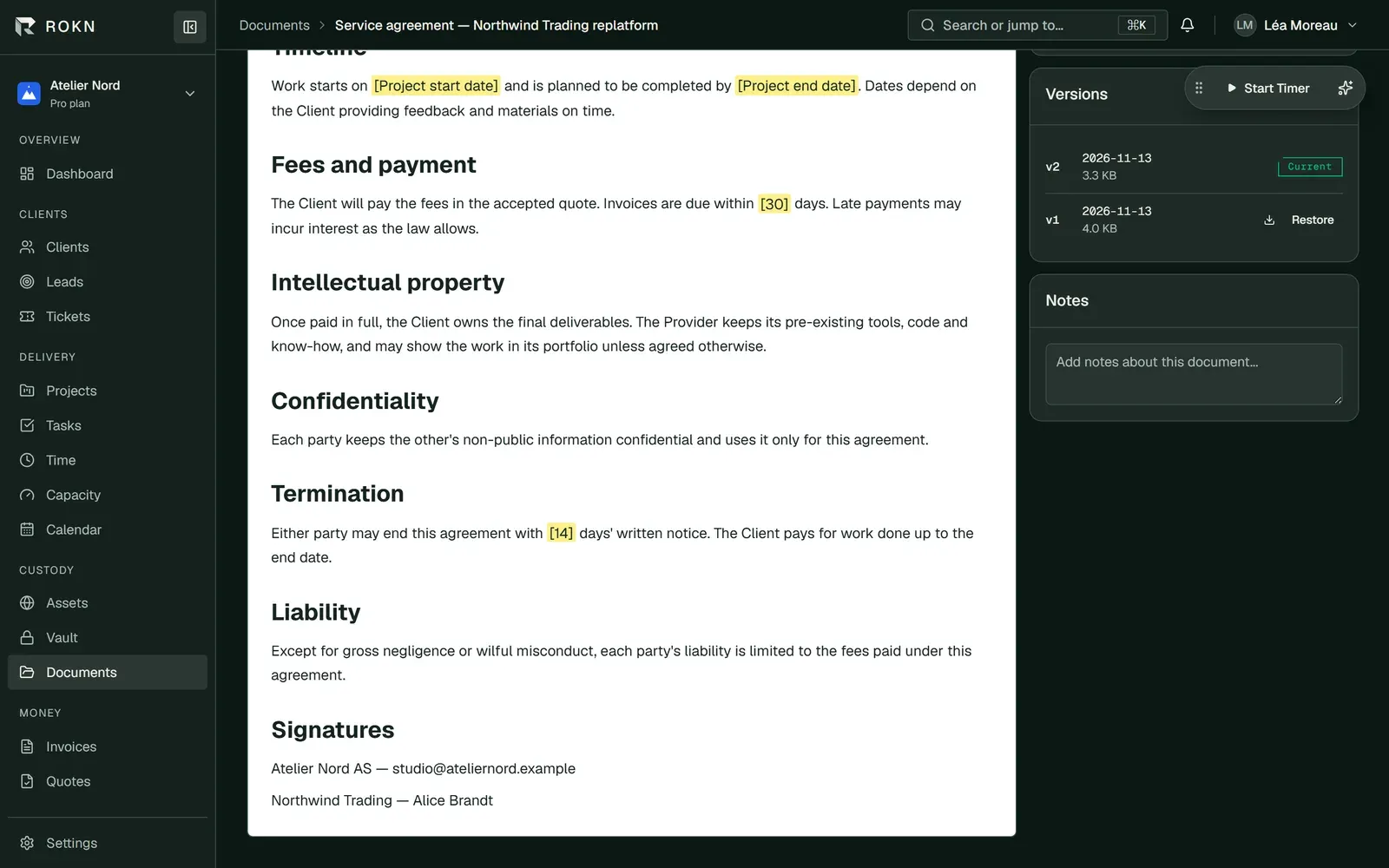
Start free, then Settings → Document templates → Use starter.
What it must contain
- Specification
What the system must do, written down or attached. Anything not in it is a change.
- Change requests
How a change is asked for, estimated and approved before work starts, and how it moves the price and date.
- Environments and access
Staging and production, who sets them up and who pays for the hosting and services the build depends on.
- Acceptance testing
How long the client has to test, what counts as a defect against a new request, and what "accepted" means.
- Warranty period
How long you fix defects in the delivered work at no charge, and what the warranty does not cover.
- Code ownership
When the client owns the code, and the status of your reusable code and of open-source components.
- Third-party services
APIs, payment providers and licences the build depends on, and who holds the accounts.
- Payment
Milestones tied to delivered, testable work rather than calendar dates alone.
- Security and data
How you handle credentials and personal data you are given access to.
- Termination and handover
What the client gets, and in what state, if the contract ends early.
Use it in Rokn
1. In Settings, Document templates, choose Use starter next to the Service agreement and replace its Services section with the specification, change, acceptance and warranty wording. 2. Keep the specification in the project’s documents. The Website build project starter already has milestones for brief, design, staging and live. 3. Create the contract from the project’s Contracts tab, add the signers and send it for e-signature (Pro and Business).