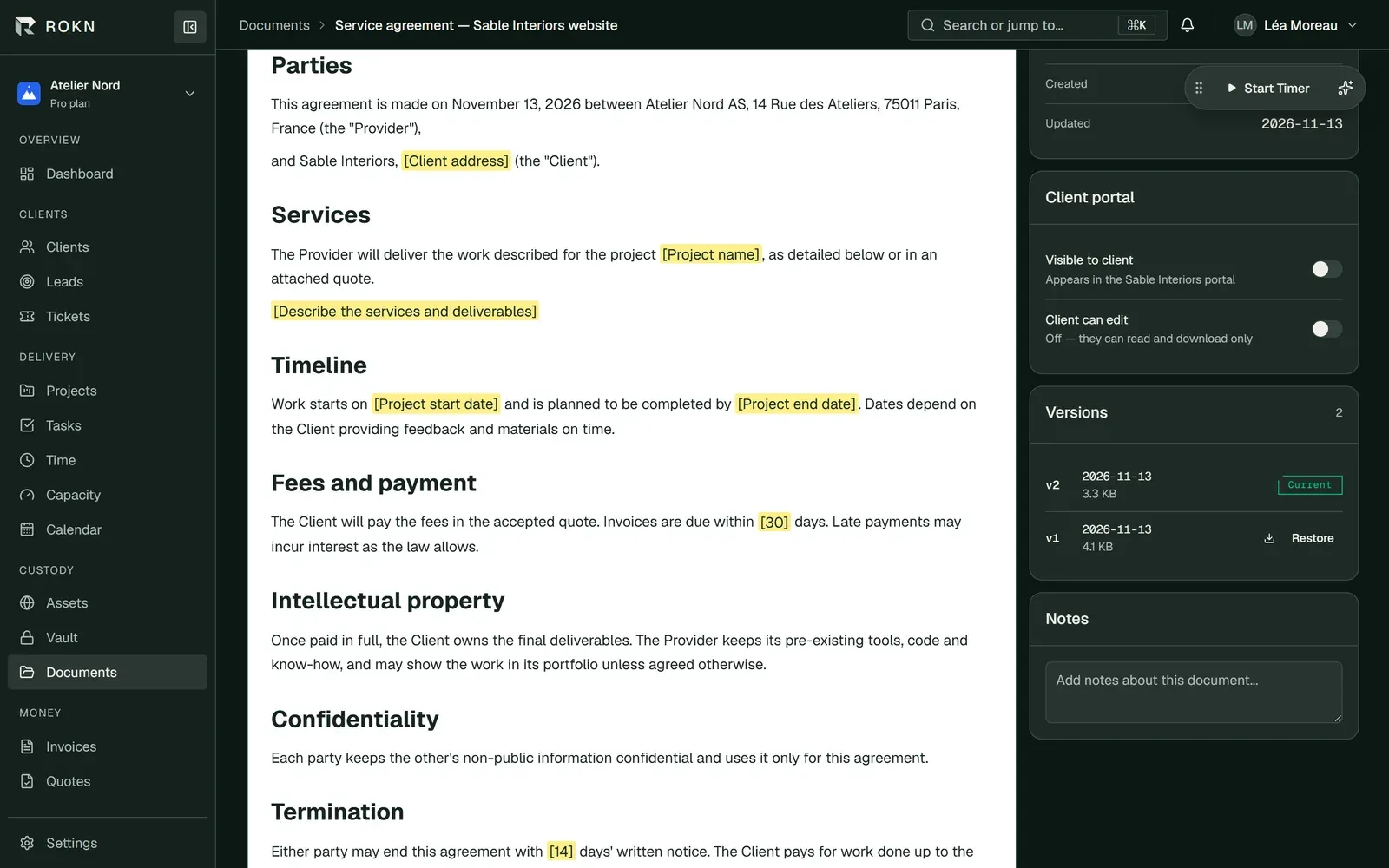

Web design contract template
A plain-language contract for a web design project: scope, revisions, content, payment, ownership and launch. Copy it, fill the brackets and adapt it.
Based on the Service agreement starter in Rokn
This template is a starting point, not legal advice. Have a qualified professional review any contract before you use it.
What it is for
A web design contract turns a quote into an agreement both sides can point to. Most disputes in design projects are about the same few things: what was included, how many rounds of changes, who supplies the content, when the money is due and who owns the result. This template puts each of those in writing before work starts. It is written for a designer or a small studio working for a business client. It is a starting point: shorten it for a small job, and have a professional review the version you use.
The template
WEB DESIGN AGREEMENT
This agreement is made on date between Your business name, address (the "Designer"), and Client name, address (the "Client").
1.The project
The Designer will design a website for the Client's business (the "Project"), as described in the attached quote dated date.
2.Deliverables
The Designer will deliver:
- Designs for number pages or templates: list
- A style guide with colours, type and components
- Design files in format
Anything not listed is out of scope and can be quoted separately.
3.Client materials
The Client will provide text, images, logo, brand guidelines, access to existing accounts by date. If materials arrive late, the timeline moves by the same number of days.
4.Process and revisions
The work has three stages: structure and wireframes, visual design, final files. Each stage includes two rounds of consolidated feedback from one named person. Further rounds are charged at hourly rate per hour.
5.Timeline and approvals
Work starts on start date and is planned to be completed by end date. The Client will approve or give feedback on each stage within 5 working days. If no feedback is given in that time, the stage is treated as approved.
6.Fees and payment
The fee is total amount plus any tax. 30% is due before work starts, 40% when the visual design is approved and 30% on delivery of final files. Invoices are due within 14 days of the invoice date. Late payments may incur interest as the law allows.
7.Intellectual property
When the Designer has been paid in full, the Client owns the final deliverables. The Designer keeps ownership of pre-existing tools, templates and know-how, and grants the Client a licence to use them as part of the deliverables.
8.Third-party assets
Fonts, images, icons and software used in the Project keep their own licences. The Client / The Designer will buy any licences needed, in the Client's name where the licence allows.
9.Launch and hosting
The Client / The Designer is responsible for hosting and for the domain. The Project is complete when the final files are delivered and accepted, or 10 working days after delivery if no problems are reported.
10.After launch
Support is not included. / Fixes to errors in the delivered work are included for 30 days. Ongoing updates can be agreed separately.
11.Confidentiality
Each party keeps the other's non-public information confidential and uses it only for this agreement.
12.Termination
Either party may end this agreement with 14 days' written notice. The Client pays for work done up to the end date.
13.Liability
Except for gross negligence or wilful misconduct, each party's liability is limited to the fees paid under this agreement.
14.Portfolio
The Designer may show the finished work in its portfolio unless the Client asks otherwise in writing.
15.Governing law
This agreement is governed by the laws of country or state.
Your business name — name, date
Client name — name, date
Start free, then Settings → Document templates → Use starter.
What it must contain
- Parties and project
Who is contracting with whom, and the one-sentence description of the project, so the rest of the document has something to refer to.
- Deliverables
Pages, templates, design files and anything else you hand over. Be specific: "8 page designs" beats "a website design".
- Client materials
What the client must supply (text, images, logo, access) and by when. Delays on their side move your dates.
- Design process and revisions
How many rounds of feedback are included, who gives feedback, and what happens to extra rounds.
- Timeline and approvals
Start date, planned completion and the approval points. Silence for a stated number of days counts as approval.
- Fees and payment
Total, deposit, milestone payments, due dates and what late payment costs. Say when each invoice is sent.
- Intellectual property
When ownership passes (usually on payment in full), and what you keep: tools, code, pre-existing work.
- Third-party assets
Fonts, stock images and plugins carry their own licences. Say who buys them and whose name the licence is in.
- Launch and hosting
Who hosts and who owns the domain, what "launch" means and when the project is considered complete.
- After launch
Whether support is included, for how long, and what a care plan would cost.
- Confidentiality, termination, liability
The standard protective clauses, kept short and symmetrical.
- Portfolio rights
Your right to show the work, unless the client opts out.
Use it in Rokn
1. In Settings, Document templates, choose Use starter next to the Service agreement and paste in the extra clauses above: revisions, client materials, third-party assets and launch. 2. The grey chips are fields: your company, the client’s name and address, the project’s name and dates, and today’s date fill in for each client. 3. Create the contract from the project’s Contracts tab, add the signers and send it for e-signature (Pro and Business). Each signer confirms their email with a code, and you keep the signed PDF.